
Blog
What is a Convector?
April 22, 2025
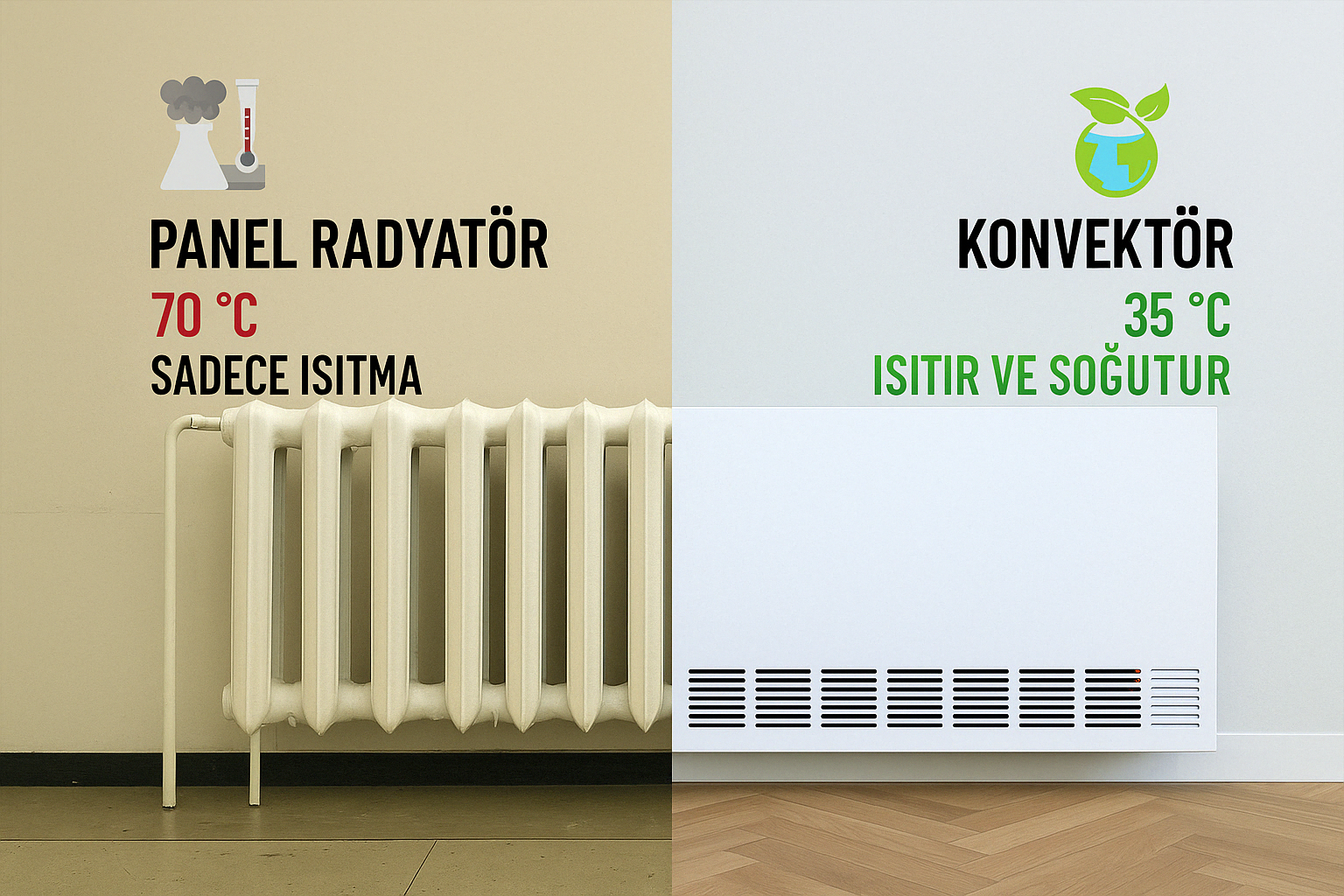
What is a Convector?
Convectors are heating elements that operate on the principle of convection, i.e., air circulation. Cold air drawn from the room heats up as it passes through the heat exchanger and is then diffused back into the environment. The cooling process works on the exact opposite principle.
The heating response of convectors is several times faster than that of traditional radiators. The main reason for this is that much less water is required for heating. For example, a 1000 W convector requires only 0.3 liters of water, while a radiator providing the same power can require up to 20 times that amount of water!
Convector vs. Radiator Comparison: Operating Costs
- When a convector is used with a heat pump, annual heating costs can be reduced by up to 50% compared to a radiator.
- Convectors have up to 88% less water volume than radiators — which creates a significant cost advantage.
- Thermostat-controlled convectors heat rooms up to 10 times faster compared to radiators.
- They provide up to 33% higher efficiency when placed near glass surfaces.
- They offer higher performance compared to radiators of similar size.
Ease of Installation and Service: Advantages of Convectors
- Their weight is up to 70% less than radiators, providing great ease in transport and installation.
- The mounting bracket also serves as a template; thus, no hole measurement is required.
- Only a hanging bracket is used for wall mounting, which simplifies the application.
- Water connection points are completely open and accessible from all directions.
- Allows for connection from within the wall; there is no need to disrupt floor plumbing.
- The outer casing is completely removable; this allows for easy cleaning and maintenance.