Floor Swirl Diffusers: Types and Applications
1. INTRODUCTION
Displacement air distribution has for many years been one of the preferred methods of cooling and providing fresh air to the occupants of sustainable buildings. This is because the principles of displacement air distribution – effectively enveloping occupants in a layer of fresh air – bring with them a host of energy efficiency and indoor climate advantages. However, traditional perforated displacement diffusers are often difficult to locate in typical commercial offices, as they are bulky and free-standing (in the form of cylindrical totems) or generally need to be integrated into walls at a low level.
With the advent of raised floor systems in many commercial offices, it has become possible to provide displacement air via a less bulky alternative – floor diffusers fed from the plenum beneath the floor. Many floor diffusers have been developed for this purpose. Among these, the most successful in an office environment have been floor swirl diffusers (floor-type swirl diffusers). This article examines the pros and cons of four basic floor swirl diffuser technologies and suggests appropriate application areas for each.
2. DISPLACEMENT AIRFLOW
The principles of displacement airflow traditionally involve supplying air that is slightly cooler than room temperature (max DT=4-5°C) and has high indoor air quality. This supply air filters out from low-level perforated diffusers with large outlet surfaces, then gently fills the floor of the living space like a cool and fresh air lake. Heat sources are enveloped in coolness and freshness as the air rises in natural convection plumes, then heat and pollutants accumulate in stratified layers at high levels and are removed from the environment. Building occupants are effectively protected in a microclimate of approximately 23°C, and the supply air temperature is typically only slightly lower, around 20°C. Despite this relatively high supply air temperature (compared to mixed-flow systems), the supply-return temperature difference exceeds -6K at standard commercial ceiling heights of 2.7m, and -12K in higher spaces. Consequently, the fan energy loss associated with higher supply air temperature is reasonable for standard office applications and actually results in savings in high ceilings. This is because the large void beneath high ceilings acts as a thermal reservoir, allowing the stratified layers floating above the occupied microclimate to capture even more heat, thereby increasing both the air temperature in the void and the supply-return air temperature difference.
From the above, the main advantages of displacement air distribution over mixed-flow systems can be identified as follows:
- Occupant indoor air quality (IAQ) is enhanced; ventilation effectiveness for seated occupants in typical commercial office applications can reach values of 2.0, which far exceeds the typical values of 0.9–1.0 for mixed-flow systems.
- Energy savings can be achieved by reducing outdoor air volumes without compromising indoor air quality.
- The low temperature difference supply air temperature allows chiller units to operate with increased coefficients of performance (COP).
- The elevated supply air temperature increases the potential for free cooling and associated energy savings.
However, the main disadvantages of traditional displacement ventilation provided via perforated wall-type or free-standing diffusers are:
- The temperature difference between the supply air and return air at standard ceiling heights is relatively low. Therefore, higher air volumes are required to cool the space, which means larger duct and fan sizes and greater fan energy consumption.
- Perforated displacement diffusers are bulky and typically about 10 times the surface area of similar mixed-flow diffusers.
- The cold and dense air filtering from displacement diffusers creates a waterfall effect as it enters the space, flowing downwards and accelerating to spread across the floor. Therefore, occupants must sit at least 1m away from the diffusers; otherwise, they are exposed to air velocities above approximately 0.18 m/s at ankle level, which causes drafts.
- Low supply air temperatures cannot be used even with high heat loads; because the air temperature at ankle level should not drop below 21°C to prevent the feeling of cold feet.
- Even with high heat loads, low supply air temperatures should not be used, as the air temperature at ankle level should not be reduced below 21°C.
- A vertical temperature gradient greater than 2K/m (e.g., higher temperature at head level than 21°C at ankle level / 23°C at face level) creates thermal discomfort and is the primary limiting factor for the capacity of displacement airflow to remove heat from the space.
3. FLOOR SWIRL DIFFUSERS FOR COMMERCIAL OFFICES
With the advent of the computer age, the use of raised floors to meet the cabling requirements of computer rooms offered a way to meet the high cooling needs of computers by combining cool airflow supplied from below with natural convection, and to remove heat from above.
As a result, many varieties of floor-mounted diffusers have been developed over the years. Most of the earliest designs were simple grilles that created strong air movement and drafts. This was acceptable in computer rooms, but by the late 1970s, demand in Germany shifted towards using underfloor air distribution in offices as well.
This was to combine the draft-free comfort, enhanced indoor air quality, and energy efficiency advantages of traditional perforated displacement systems with underfloor ventilation. In addition, increased flexibility and lower life cycle costs could be achieved thanks to raised floor systems.
However, the violent/penetrating airflows produced by simple floor grilles created drafts and stirred up heat at high levels, mixing heat and pollutants back into the occupied space. This not only destroyed the high temperature difference between supply and return air required for maximum heat removal with minimum fan energy, but also the microclimate around occupants that provided superior indoor air quality. These systems were plagued with complaints about discomfort and drafts, and it was only with proper engineering solutions for diffusers – using swirl technology to solve these problems – that underfloor airflow for offices became truly viable.
3.1 Horizontal Throw Floor Swirl Diffusers
Over the years, many different displacement floor diffuser designs have been introduced. Among these, the most popular are typically models that blow air with a gentle, horizontal swirl pattern from a 200 mm diameter surface at up to 30 L/s (Figure 1). The swirl throw ensures a rapid reduction in outlet velocity to minimize the risk of drafts for nearby occupants. The gentle and horizontal discharge ensures minimal mixing of the supplied air with heat and pollutants at upper levels, maximizing indoor air quality and typically providing ventilation effectiveness of 1.3 to 2.0 for seated occupants.
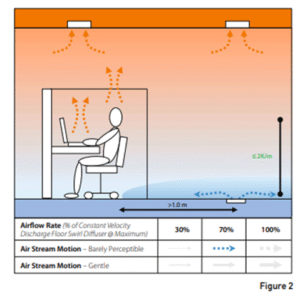
While indoor air quality is maximized, horizontal throw floor swirl diffusers are affected by the following limitations (Figure 2):
- Due to the risk of drafts at ankle level resulting from the radial spread of horizontally thrown supply air, it is recommended to maintain a minimum distance of 1m between the diffuser and the nearest seating position. Providing this minimum distance is often difficult, especially in enclosed or multi-purpose spaces such as workstations, meeting rooms, or task groups.
- The low air movement at head level, resulting from the air pattern being gently directed towards the floor, is not suitable for the comfort preferences of all occupants. This is because many people prefer perceptible, or even increased, air movement and complain of stuffiness when this is not present. This is particularly true for tropical regions and the Asia-Pacific region in general.
- The cool supply air lake filling the floor causes the air temperature at ankle level (0.1m height) to be lower than the air temperature at the head level of seated occupants (1.1m height). For a standard 2.7m ceiling height, these systems are typically limited to a maximum specific sensible heat load of approximately 50 W/m² to prevent the vertical temperature gradient from exceeding 2K/m and thus the feeling of “cold feet, warm head”.
Horizontal throw floor swirl diffusers maximize indoor air quality and are well suited for applications with low equipment heat loads or high ceilings, or for core zones with low occupant density. However, when combined with the high equipment heat loads and increased occupant densities typical of most offices, and ceiling heights generally not exceeding 2.7m, this severely limits the applications where these diffusers can be used.
Nevertheless, these horizontal throw diffusers perform better than their upward throw counterparts in situations with low heat loads, such as libraries, where diffusers need to be widely spaced. This is because horizontal throw floor swirl diffusers fill the floor with cool air, which then travels significant distances towards heat sources drawn upwards by natural convection.
3.2 Vertical Throw Floor Swirl Diffusers
Approximately 30 years ago, the vertical throw floor swirl diffuser was invented for the underwriters' area of the iconic Lloyds building at 1 Lime St in the City of London. This was to eliminate the excessively high heat loads in the area without exposing occupants to an excessive vertical temperature gradient and to provide enhanced indoor air quality (typically, a vertical throw floor swirl diffuser provides a ventilation effectiveness of 1.3 to 2.0 for seated occupants).
Floor swirl diffusers with a 200 mm diameter surface (Figure 3) are designed to provide a highly inductive vertical throw. This creates mixing up to the head height of seated occupants, while the stratified heat and pollutant layers above this level remain undisturbed. This is because vertical throw floor swirl diffusers ensure a rapid decrease in supply velocity and rapid temperature equalization of the supply air with the ambient microclimate air.
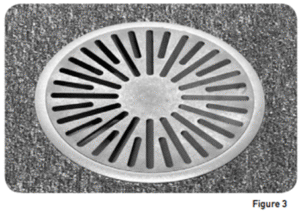
Compared to horizontal throw swirl diffusers, both much higher air volumes (up to 50 L/s) and much larger supply-return temperature differences (up to –10 K for a 2.7m ceiling height) are achieved. This makes it possible to remove heat loads of up to 200 W/m² in offices with heights of 2.7–3.0m.
In other words, in typical office environments, vertical throw floor swirl diffusers can provide more than three to five times the maximum sensible cooling capacity of similar horizontal throw systems (i.e., floor swirl or perforated wall-mounted) without exposing occupants to drafts or excessive vertical temperature gradients.
The great success of the vertical throw floor swirl diffuser in these and similar applications marked the beginning of a new era in displacement air distribution in offices.
The demand for personalized comfort led to the addition of the ability to adjust the airflow for the user. The need for individual diffuser control, referred to as Task/Ambient Conditioning (TAC), increased following the work of leading researchers such as Bauman, who strongly advocated for these systems.
This emerged particularly after research conducted by the Building Owners and Managers Association (BOMA) which surveyed 1829 office tenants in the US and Canada.
Based on this survey, Bauman concluded: “The only item that appears on both the list of most important features (96%) and the list of features tenants are least satisfied with (65%) is the ability of tenants to control temperature.”
Bauman also cited de Deer's [9] finding that building occupants without individual control capabilities were twice as sensitive to temperature changes as those with individual thermal control.
Webster states that user-controlled underfloor air distribution systems “increase employee satisfaction and productivity by giving employees more control over their local environments and improving the quality of indoor environments.”
However, Webster demonstrates that if the airflow in vertical throw floor swirl diffusers drops too low, an excessive vertical temperature gradient (i.e., “cold feet, warm head” discomfort) occurs. This is because the mixing height of the swirl flow falls significantly below the head level of seated occupants, thereby exposing the face area to the higher temperatures of the stratified zone. This can result from user control of the diffusers if occupants significantly throttle the dampers of vertical throw floor swirl diffusers.
Today's vertical throw floor swirl diffusers are manufactured by various manufacturers to provide highly inductive airflow in the vertical direction and typically allow for personal adjustment of the airflow by the user through manual rotation of the diffuser face (clockwise to throttle the damper; counter-clockwise to open it); thereby meeting the requirements for user-adjustable credits under Green Star.
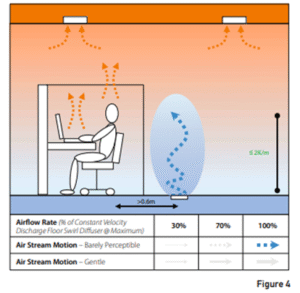
However, there are the following limitations for these diffusers (Figure 4):
- A minimum distance of 0.6m between the diffuser and the nearest seating area is generally recommended to prevent the radially spreading and vertically thrown airflow from colliding with seated individuals. Providing this minimum distance is often difficult, especially in high-density offices or “plug-and-play” flexible workspaces.
- The high-induction vertical throw creates air movement that is barely perceptible, which is not suitable for the comfort preferences of all occupants; many people prefer more pronounced or partially increased local air movement.
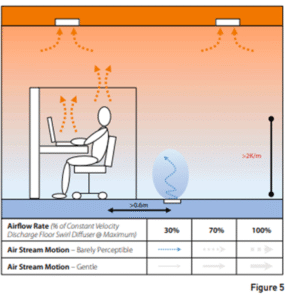
- To be effective, a wide range of airflow adjustment is required for the user to personalize their local climate solely through airflow adjustment. However, this brings with it the following problems (Figure 5):
- Significant throttling of the diffuser's airflow can lead to more air exiting other diffusers connected to the same plenum box. This can create a chain reaction (snowball effect) where users experiencing local overcooling throttle their diffusers. In other words, a situation of successive diffuser shutdowns can occur, and as a result, the system cannot provide enough air to respond correctly to changing thermal loads. This largely leads to a loss of thermostatic control in the zone.
- The snowball effect resulting from diffuser throttling is detrimental to indoor air quality; as it generally leads to insufficient fresh air supply to the space.
- As the airflow through the floor-type swirl diffuser decreases, the throw height also decreases. However, ideally, the throw height should reach the head level of seated individuals to prevent an excessive vertical temperature gradient. A significant reduction in airflow leads to insufficient vertical throw. As a result, the stratified warm air layer in the upper zone sags downwards, reaching the head level of occupants. This causes thermal discomfort (“cold feet, warm head”) and a stuffy feeling due to stagnant air at face level.
4. The operation of the optional integrated motorized VAV damper in the diffuser. – Used as a secondary thermostatic control tool in areas with highly fluctuating heat loads, such as meeting rooms – often causes occupant discomfort as described in 3c.
Vertical throw floor swirl diffusers perform well in environments with moderate to very high heat loads, as long as they are not positioned directly next to seating areas. However, especially in applications where heat loads fluctuate significantly, such as perimeter zones, the range of airflow that users can control should be kept small. These diffusers are extremely suitable for areas used for short periods or zones with very high thermal loads.
I am text block. Click edit button to change this text. Lorem ipsum dolor sit amet, consectetur adipiscing elit. Ut elit tellus, luctus nec ullamcorper mattis, pulvinar dapibus leo.
3.3 Adjustable Throw Floor Swirl Diffusers
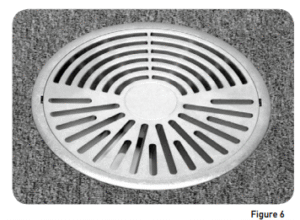
To prevent users from changing the airflow from negatively affecting the overall cooling performance and indoor air quality of the system, an adjustable throw floor swirl diffuser has been developed that allows for personal comfort adjustment (Figure 6). These diffusers create a swirl airflow with strong induction along an inclined axis. Thanks to this swirl effect, the velocity of the supply air rapidly decreases, and its temperature instantly equalizes with the ambient air. The user can adjust the air direction by rotating the diffuser face; thus meeting Green Star user adjustability criteria.
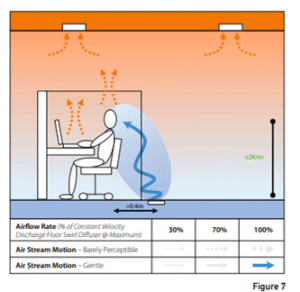
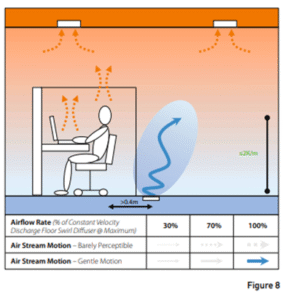
Compared to vertical throw swirl diffusers, adjustable throw floor diffusers have the following advantages (Figures 7 and 8):
- While it is ideal to place the diffuser 0.4m away from seating, it is possible to place the diffuser immediately next to seating without the risk of drafts, thanks to the ability to redirect the airflow.
- The higher local air movement created by directing the diffuser's airflow towards the user eliminates the feeling of stuffiness for users who prefer increased air movement. If less air movement is desired, the user can turn the diffuser face to direct the airflow away.
- When air direction adjustment is used for personalized effective temperature adjustment instead of airflow adjustment, adjustable throw floor diffusers offer the following advantages:
- Since the airflow cannot be throttled by the user, indoor air quality is not compromised.
- Since the airflow cannot be throttled by the user, thermostatic control is not compromised.
- The throw height remains largely constant; this eliminates the feeling of “cold feet, warm head” and the problem of stuffiness, regardless of user adjustment.
However, adjustable throw floor swirl diffusers have some limitations:
- When ambient air adjustment is offered to the user via only one of the two possible adjustment methods (i.e., air direction), the full range of personalized comfort cannot be maximized.
- Since a vertical throw option with high induction and rapidly decreasing supply velocity is not offered, they are not suitable for applications where this type of air pattern is required.
- A motorized VAV damper option is not available for these diffusers, as this would cause fluctuations in throw distance and negatively affect both the vertical temperature gradient in the occupied space and the user's control over air movement.
Adjustable throw floor swirl diffusers are ideal for environments with moderate to high heat loads where personal comfort adjustment is desired, and they provide this adjustability without disrupting the vertical temperature balance for occupants. However, they do not offer a motorized VAV option; because their main advantage – providing effective mixing up to the head level of seated individuals regardless of user adjustment – would be lost in this case.
3.4 Constant Throw Velocity Floor Swirl Diffusers
Constant velocity throw makes it possible to achieve a largely constant throw distance up to the head level of seated individuals, even when the airflow is adjusted. Thus, even when the user sets the diffuser airflow to a reduced setting, an excessive vertical temperature gradient does not occur in the occupied space.
This largely constant throw distance combined with airflow adjustability, coupled with a directed inclined airflow, further enhances the potential for the user to personalize their local thermal environment. This is because increasing or decreasing airflow can be directed towards or away from the user.
The thermal comfort advantage provided by such a wide range of adjustability for the user is particularly important in areas where loads fluctuate strongly, such as perimeter zones, which often require the widest range of personalized customization.
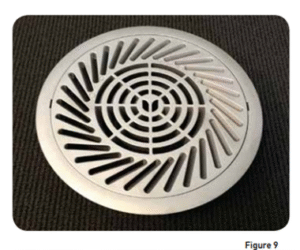
The constant throw velocity floor-type swirl diffuser (Figure 9) allows the diffuser components to be mounted in three different configurations thanks to two adjustable dampers (however, only two of these configurations provide largely “constant velocity” throw):
- User-adjustable throw angle, rotation, and airflow (throw is largely “constant velocity”).
- Inclined throw with user-adjustable rotation and airflow (throw is largely “constant velocity”).
- Vertical throw with user-adjustable airflow (throw is variable velocity).
All three configurations above meet the Green Star requirements for user-adjustable credits.
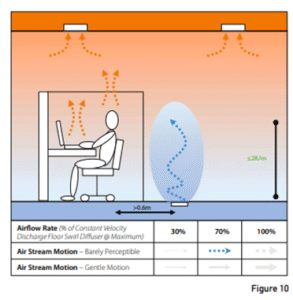
Configuration 1 offers the user the ability to adjust airflow (limited by adjustable stoppers), direction (by rotating the inclined throw pattern), and angle (provides minimum air movement in the vertical position).
This configuration provides the widest thermal comfort adjustability: Counter-clockwise rotation of the diffuser face provides a directed inclined airflow with increased airflow and gentle air movement that can be directed towards the user (Figure 7); clockwise rotation creates a vertical throw with reduced airflow, directed away from the user, and in this case, air movement is almost imperceptible (Figure 10). Throw height is largely constant.
This is the most typical configuration for reconfigurable offices, especially in draft-sensitive applications.
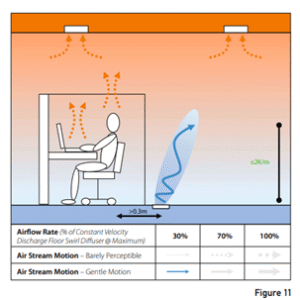
Configuration 2 offers the user the ability to adjust airflow (limited by adjustable stoppers) and direction (by rotating the inclined throw pattern).
This configuration provides gentle air movement in the space, regardless of the airflow setting: Counter-clockwise rotation of the diffuser face provides an inclined airflow with increased airflow that can be directed towards the user (Figure 7); clockwise rotation creates an inclined airflow with reduced airflow that can be directed away from the user (Figure 11). Throw height is largely constant.
This is the most typical configuration for offices and workspaces in tropical regions and many parts of Asia-Pacific, where air movement is desired to be felt even at low velocities.
Configuration 3 provides a vertical throw and offers the user airflow adjustability (limited by adjustable stoppers).
A strong throw velocity reduction occurs regardless of the airflow setting, and air movement in the space is almost imperceptible (Figures 4 & 5). Throw height varies depending on the airflow.
This configuration is typically used in transition areas or zones with very high thermal loads.
Specifically, the constant throw velocity floor swirl diffuser offers the following advantages:
- In Configurations 1 and 2, it is possible to place the diffuser immediately next to seating areas without creating a risk of drafts (although a minimum distance of 0.4m is preferred for optimal air movement control).
- In Configurations 1 and 2, while user airflow adjustment is possible, mixing up to the head level of seated occupants is largely maintained. Thus, even though airflow is adjustable, the feeling of stuffiness and the “cold feet, warm head” effect are eliminated.
- In Configurations 1 and 2, counter-clockwise rotation of the diffuser face increases the airflow of a gentle, inclined airflow that can be directed towards the user, maximizing the personalized cooling effect.
- In Configuration 1, clockwise rotation of the diffuser face reduces the airflow and produces a high-induction throw in the vertical direction, creating barely perceptible air movement. This provides the lowest level of personalized cooling. In contrast, in Configuration 2, clockwise rotation reduces the airflow of the inclined and rotatable airflow, creating gentle surface-level air movement that can be adjusted by direction.
- Configuration 1 optionally offers electric VAV damper operation. This provides user-personalized air direction and air movement adjustment independently of the automatically adjusted airflow.
- Configuration 3 (not a constant velocity configuration) offers high-induction air supply with rapid throw velocity reduction; it creates barely perceptible air movement and allows the user to adjust the airflow.
The disadvantages of constant throw velocity floor swirl diffusers are:
- Configuration 3 does not offer largely constant velocity throw and therefore does not maintain a constant vertical throw height up to the head level of seated occupants. Throw height varies depending on the user-adjustable airflow (Figures 4 and 5). Allowing a wide range of airflow adjustment in this configuration can create a feeling of stuffiness and the “cold feet, warm head” effect.
- Due to the option of being assembled with any of the three different configurations, clear defined specifications are required from the project engineer regarding which configuration and damper settings to use.
- The presence of two adjustable dampers potentially leads to a more complex installation process.
Constant throw velocity floor swirl diffusers offer the advantages of three different configurations:
- Maximizing airflow, air direction, and air movement adjustability (suitable for most reconfigurable office applications by the user),
- Offering airflow and direction adjustment while maintaining gentle air movement at head level (generally suitable for offices and workspaces in tropical regions and Asia-Pacific),
- Configurations that offer only airflow adjustability, with a vertically directed and almost imperceptible air movement (suitable for temporary areas or applications with very high heat loads).
Only the last of these three configurations cannot largely maintain mixing up to the head level of seated occupants, regardless of user settings. Optional motorized VAV damper operation is available for Configuration 1, which provides personalized air direction and air movement adjustability up to the head level of seated occupants within the VAV operating range.
4. CONCLUSIONS
In addition to the floor swirl diffusers presented above, many different designs are available, especially in terms of adjustability. For example, some models allow for horizontal to vertical swirl adjustment, while horizontal throw floor swirl diffusers offer the user the ability to adjust the airflow. However, this article has focused on the most common floor swirl diffuser designs.
Specifically, horizontal flow floor swirl diffusers have been found to be suitable for areas with low heat loads, such as libraries.
Vertical flow floor swirl diffusers, on the other hand, are the most suitable solution for temporary areas and applications with very high heat loads in commercial offices. These diffusers generally offer the user the option to adjust the airflow, but this should only be applied within a limited range and is best used in areas such as core zones with low heat loads and minimal thermal fluctuations. Optional motorized VAV adjustment can negatively affect thermal comfort by increasing the vertical temperature gradient as the diffuser throw decreases when the airflow is reduced.
Adjustable throw floor swirl diffusers offer the user the ability to adjust the air direction, thereby largely maintaining the throw up to the head level of seated occupants regardless of the personalized setting. These diffusers are suitable for offices, including perimeter zones and areas with high heat load fluctuations, where user adjustment is required. However, these diffusers do not offer motorized VAV modulation, which is often necessary in areas such as meeting rooms.
Constant throw velocity floor swirl diffusers maximize the user's adjustability of the local thermal environment by offering airflow, air direction, and air movement adjustment (except for the vertical throw configuration), largely maintaining the throw up to the head level of seated occupants. These diffusers adapt to different user air temperature and air movement preferences. They eliminate the risk of “cold feet, warm head” even when motorized VAV control is provided. Optional motorized VAV control also allows the user to adjust personalized air direction and air movement. Constant throw velocity floor swirl diffusers are the most suitable solution for commercial office applications where maximizing user comfort and indoor air quality is the goal.
5. REFERENCES
(a) Books and handbooks: CIBSE Continuing Professional Development: Tutorial – Underfloor Air-Conditioning, 2000
(b) Journal articles and conference papers:
Badenhorst S: “Energy Efficient Air Distribution for Comfort”, IRHACE Journal Vol 8, No 6, 1996 Bauman FS: “Giving Occupants What They Want: Guidelines for Implementing Personal Environmental Control in your Building”, World Workspace Conference, Los Angeles CA, 3–5 Oct 1999
Brown MR: “Underfloor Air Conditioning Systems – Principles and Applications”, Carrier Global Engineering conference, May 2000
Center for Building Performance and Diagnostics: “Flexible and Adaptive HVAC Distribution Systems for Office Buildings”, Air Conditioning and Refrigeration Technology Institute, Walking on Air Energy Presentation, 2001
Daly A: “Underfloor Air Distribution: Lessons Learned”, ASHRAE Journal, May 2002-08-16
Gupta V, Woods JE: “The Performance of Underfloor Air Distribution Systems”, High Performance Buildings Conference, Nashville Tennessee, 2007
Hui SCM, Li Y: “Enhancing Sustainability of Buildings by using Underfloor Air Conditioning Systems”, Symposium on System Design and Operation for Enhancing Sustainability of Buildings, Chongqing, China, 8-10 July 2002
Loudermilk, K J: Underfloor Air Distribution Solutions for Open Office Applications”, ASHRAE Transactions, Vol 105, Part I, 1999
Stanke D: “Underfloor Air Distribution”, Engineers Newsletter, Vol 30, No 4, 2001
Webster T: “Unerfloor Air Distribution: Thermal Stratification”, ASHRAE Journal, May 2002
Woods EW, Novosel D: “Comparative Analysis of Conventional and Underfloor Air Distribution System Performance using the Air Diffusion Performance Index Method”, NEMI, 2008
6. REFERENCES
1. Badenhorst S: “Underfloor Air Distribution”, AIRAH Indoor Air Quality Conference, Canberra, Australia, 2002 2. DIN 1946 Part
2 (January 1994): Heating, Ventilation and Air Conditioning, Requirements relating to Health (VDI Code of practice).
3. Inatomi TA, Abe V, Leite BCC: “Energy Consumption of Underfloor Air Distribution Systems: A Literature Overview”, Conference on Low Energy Architecture, Geneva, Switzerland, 2006
4. Webster T, Lukaschek W, Dickerhoff D, Bauman F: “Energy Performance of Underfloor Air Distribution (UFAD) Systems Part II: Room Air Stratification Full Scale Testing”, Center for the Built Environment, University of California, Berkeley, 2007.
5. Krantz Komponenten: “Air Distribution Systems – Floor Air Outlets”, K 72e/05-1
- Göbel A [Krantz Komponenten]: telephonic interview 25/04/2013
7. Bauman FS: “Task/Ambient Conditioning Systems: Engineering and Application Guidelines”, Center for the Built Environment, University of California Berkeley, World Workplace Conference, Los Angeles CA, Oct 1999
8. Building Owners and Managers Association (BOMA) International and ULI (the Urban Land Institute): “What office tenants want”, BOMA/ULI office tenant survey report, 1999
9. de Dear R, Grager GS: “Developing an adaptive model of thermal comfort and preference” ASHRAE Transactions Vo. 104(1) 1999