Ventilation Systems in Large Volume Buildings
Ventilation Systems in Large Volume Buildings: How to Choose the Right Air Distribution?
Large and high-volume indoor spaces stand out not only for their architectural aesthetics but also for the challenges they present in terms of ventilation. From sports halls to airports, atriums to theaters, many building types necessitate the correct selection of different air distribution systems. In this article, we will discuss the design criteria for ventilation systems in large volumes, as well as the advantages and limitations of the systems used.
Challenges of Large and High Volumes
Ventilation in large volume buildings not only provides fresh air but also plays a critical role in creating a comfortable indoor environment.
The main challenges faced by designers include:
- Effectively delivering conditioned air to the occupied zone
- Ensuring homogeneous air distribution throughout the entire volume of the occupied zone
- Mezzanines and ceiling geometries at different heights
- Dynamic differences between heating and cooling modes
- Adapting to aesthetic and architectural constraints
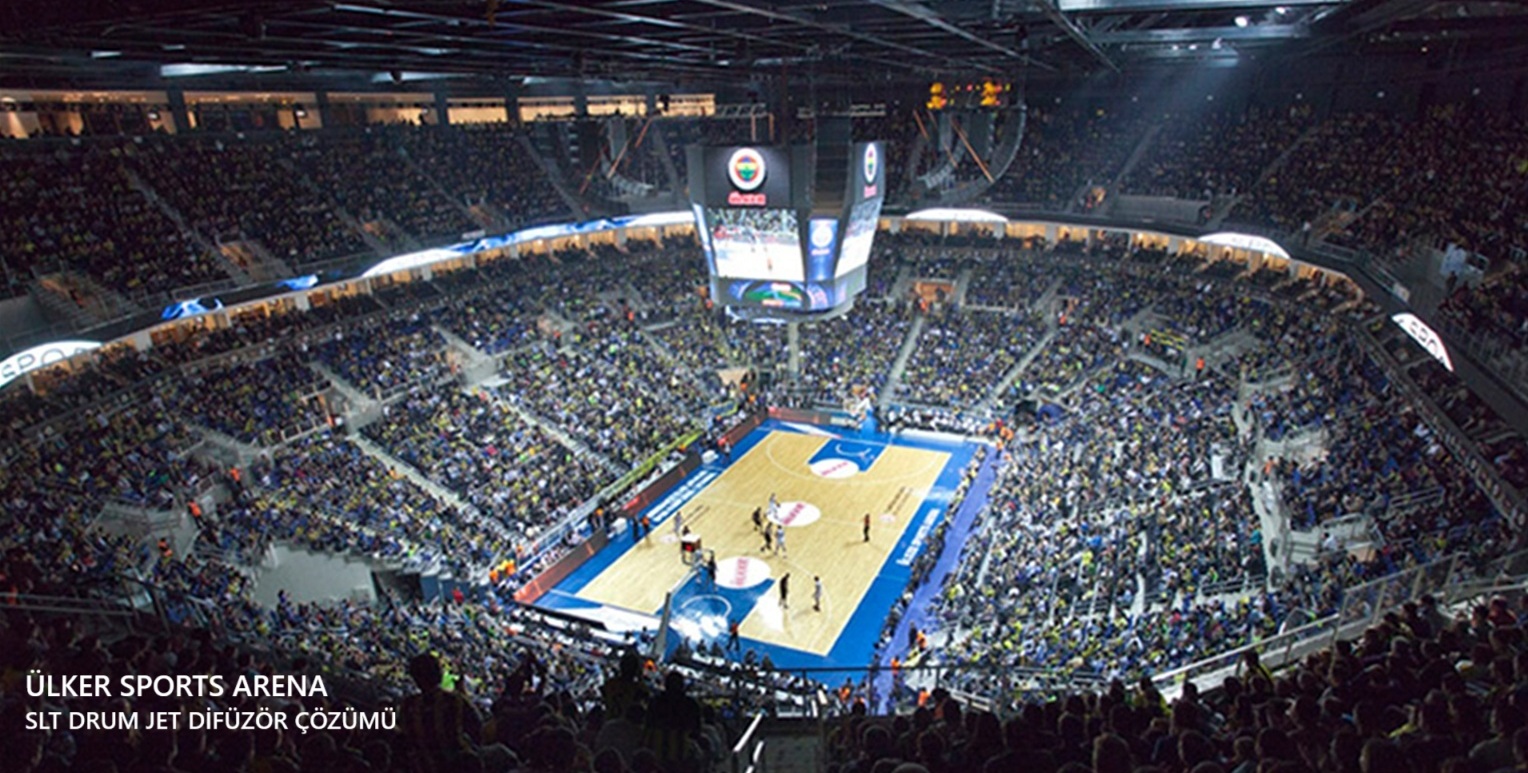
Mixed Ventilation Systems: Flexibility and Application Diversity
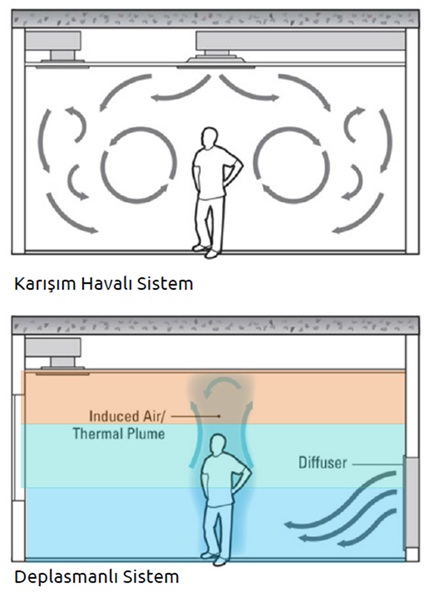
Mixed ventilation, the most commonly used system, offers great freedom in diffuser options. The system aims for the high-velocity supply air to mix with the room air and become homogeneous.
Advantages:
- Diffuser options suitable for all types of architecture (slot, swirl, jet nozzles, etc.)
- Adaptation in cooling and heating modes
- Especially suitable for projects where the entire volume needs to be conditioned
Points to consider:
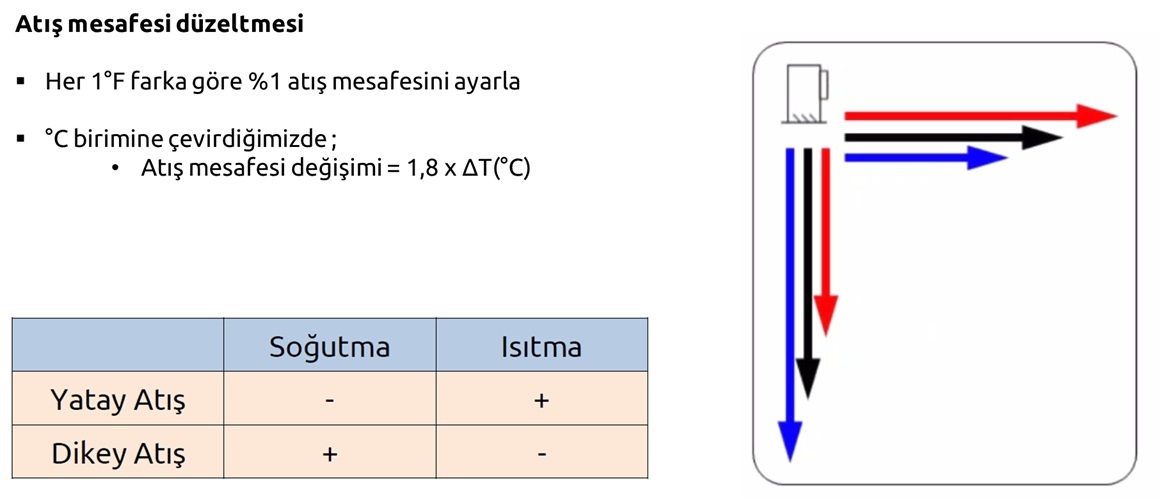
- Throw distances should be corrected according to the ΔT between the supply air and room temperature. If this correction is not made, the air may drop before reaching the occupied zone.


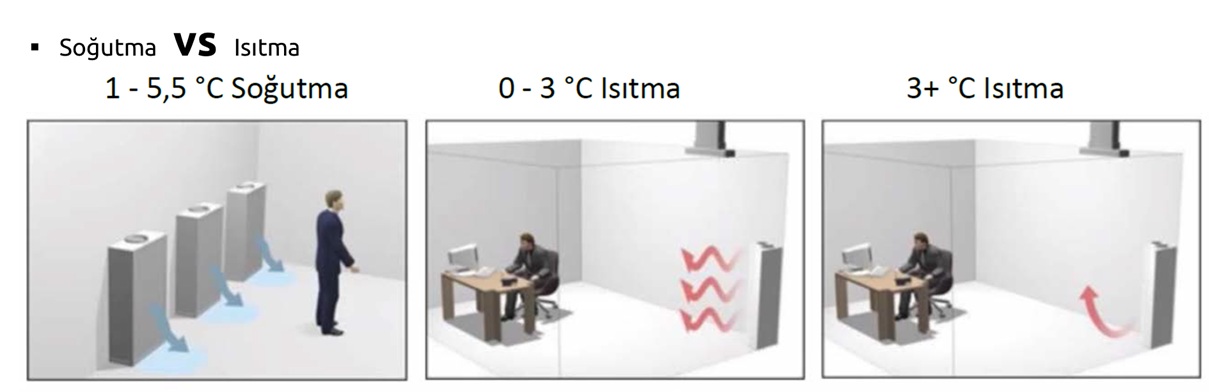
Displacement Ventilation: Direct Solution for the Occupied Zone
In displacement systems, air is supplied to the occupied zone at low velocity and with a small temperature difference. Instead of mixing, vertical stratification is achieved in the environment.
Highlights:
- Energy efficiency by conditioning only the occupied zone
- Contaminants are pushed upwards and removed from the environment
- Aesthetic diffuser solutions that can be integrated into the architecture
Limitations:
- Additional solutions may be required for heating (underfloor heating, convection supports)
Hydronic Systems: Water for High Energy Efficiency
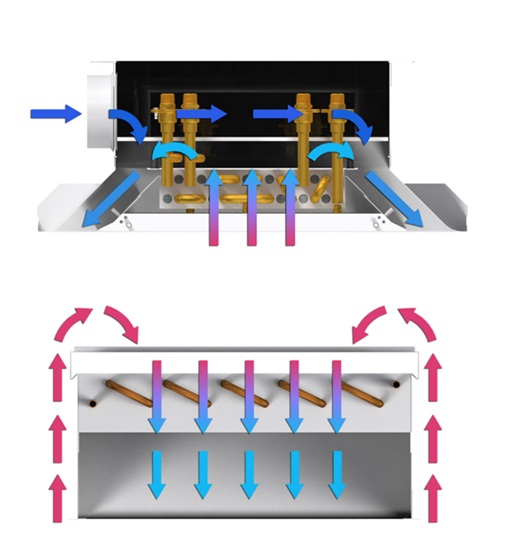
Water-based solutions are preferred especially in buildings with high heating/cooling loads. They have a wide range of applications with options such as radiant panels and active/passive chilled beam systems.
Radiant Systems:
Provides heat transfer between surfaces via radiation
Minimizes air volume, is quiet and hygienic
Chilled Beam Systems:
Effective air mixing thanks to high induction ratio in active systems
Passive beams are for cooling only and are used in combination with displacement systems
Active and Passive Beams
- Primary air pressurizes the plenum and allows it to pass through the nozzles
- Induces room air to pass through the coil inside
- Mixed ventilation – not stratified
- Creates excellent induction ratios (min 2:1 – typically 4-6:1)
Area-Based Application Examples
Indoor Pools
Air is directed towards glass surfaces to reduce the risk of condensation.
In highly corrosive environments, the selection of diffuser and duct materials is vital.
Atriums
They have a complex structure with high solar loads, day-night temperature differences, and high infiltration values.
Slot diffusers and linear bar grilles provide a good harmony with architectural aesthetics.
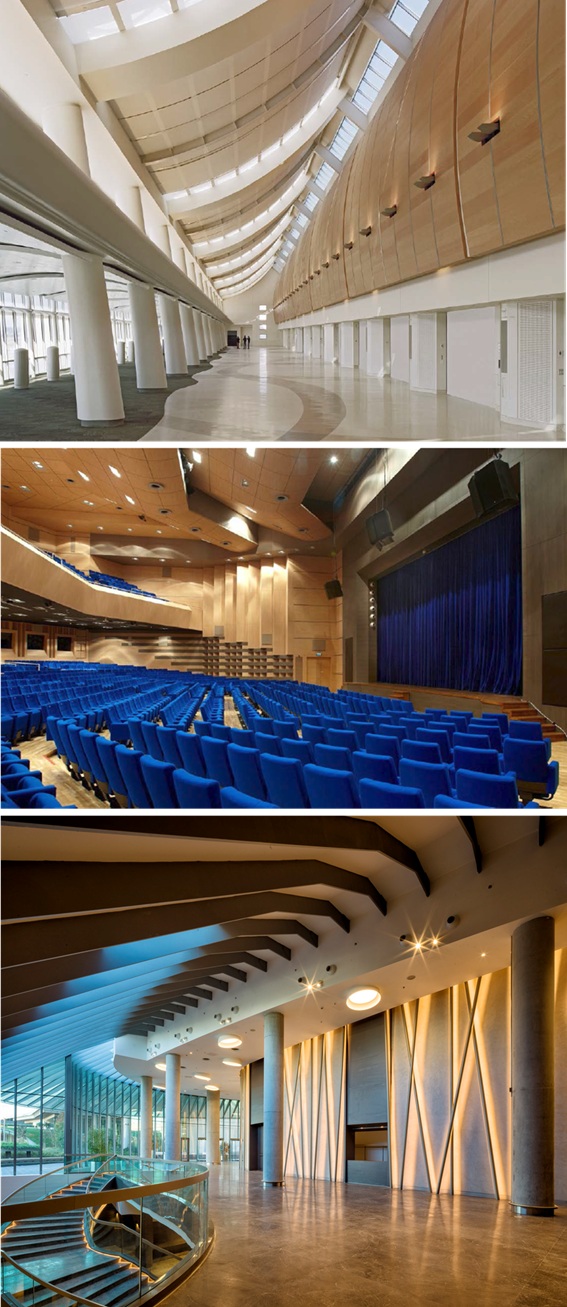
Conference Halls / Theaters
The comfort of seated audiences is paramount. Displacement floor diffusers can be integrated under seats.
Alternatively, mixed systems with high ceiling swirl diffusers are commonly used.
Airports
Homogeneous air distribution is critical due to large open spaces and continuous human traffic.
Jet nozzles target occupied zones, while displacement systems can be aesthetically integrated.
Every large volume building has its unique HVAC requirements. The main goal in a successful design is to ensure comfort without compromising aesthetics and to increase energy efficiency. Therefore, it is necessary to evaluate a wide range of products, from mixed systems to displacement solutions, and from hydronic systems to floor diffusers, according to project requirements.
Remember, with the right product, the right placement, and the right analysis, it is possible to create excellent HVAC comfort in high-volume buildings.
You can use the button below to download our detailed PDF presentation supported by visuals.
Author : Ender Bilgin